Quick answer
Sending money to Brazil to buy property legally means wiring it through a bank or broker authorized by the Central Bank of Brazil, under a foreign exchange contract in your own name that states the purchase as its purpose. That contract, kept together with the deed, proves where the money came from, supports any declaration the Central Bank rules require under Lei 14.286/2021 and is what lets you send the money back when you sell.
Key points
- Brazilian exchange rules look at where you live, not your passport: a Brazilian living abroad is also a non-resident.
- The money should leave an account in the buyer's name and arrive in the buyer's name, with "property purchase" as the purpose.
- Money that enters outside the official exchange leaves no proof, and informal exchange is a crime in Brazil.
- When you sell, the bank asks for the entry documents, the deed and proof of the capital gains tax.
How money for a property legally enters Brazil
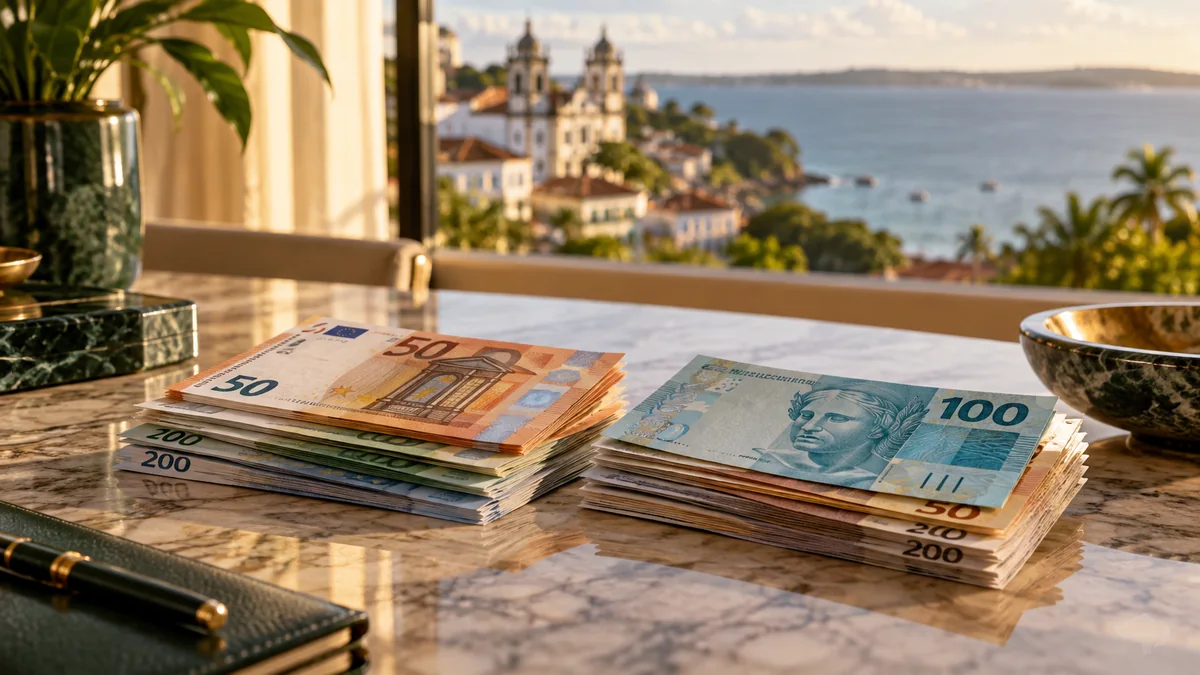
All foreign currency used to pay for a property enters Brazil through a foreign exchange contract with an institution authorized by the Central Bank. The contract names who sends, who receives in Brazilian reais and what the money is for.
Your bank at home sends the funds; a Brazilian bank or exchange broker converts them and credits the reais. In between, a foreign exchange contract (contrato de câmbio) is signed. It is not a formality. It is the document that ties the money in your foreign account to the property that will be registered in your name in Bahia.
The rules since Lei 14.286/2021
For decades, foreign capital followed Lei 4.131/1962 and its registration system. Since December 31, 2022, the new foreign exchange framework, Lei 14.286/2021, applies. It simplified the exchange market and left to the Central Bank of Brazil the details of who must declare what, by when and above which amount.
Whether a direct property purchase by an individual non-resident needs a declaration in the Central Bank system depends on the regulation in force and the amount. The exchange contract in your name is needed in every case.
Residence, not nationality
The exchange rules classify people by where they live.
An American living in Lisbon, a Briton living in London and a Brazilian living in Miami are all non-residents for this purpose and follow the same proof route. A foreigner who already lives in Brazil follows the rules for residents, including the Brazilian income tax return.
Four ways to pay a Brazilian seller, compared
Only an official exchange into an account in the buyer's name proves the purchase from end to end. The other routes leave gaps that the notary, the bank or the tax authority will ask about later.
| Route | Proof on the deed | Money back when you sell | Exposure |
|---|---|---|---|
| Official exchange into the buyer's account in Brazil | Full: exchange contract and statement | Documented from day one | Low, if the purpose is right |
| Official exchange straight to the seller's account | Good, if the contract provides for it | Documented, depends on the records | Medium: no account of yours in between |
| Payment abroad, buyer to seller | Partial: the notary needs an explanation | No entry in Brazil to repatriate | High: needs a case review first |
| Informal exchange, outside the system | None | No legal route | A crime, and a purchase with no proof of payment |
Sources: Lei 14.286/2021; Lei 7.492/1986, art. 22. Prepared by Gabriela Pereira Advocacia, October 14, 2026, as a reference for a first conversation; the route for your case depends on your country, your bank and the contract.
Step by step: from the bank quote to the deed
Plan the transfer before money leaves your account, sign the purchase agreement before the first wire, and keep every document. Done in this order, the notary and the registry accept the payment without questions.
Get your CPF.
The Brazilian taxpayer number identifies you on the exchange contract and on the deed. Read how to get a CPF from abroad.
Sign the agreement first.
The promissory purchase agreement should state the price, the dates and how each payment will arrive.
Choose the receiving account.
An account in your name in Brazil, or the seller's account named in the agreement.
Wire with the right details.
The exchange contract shows your name, your CPF and "property purchase" as the purpose.
Pay the seller traceably.
From the account that received the transfer, by bank transfer, never in cash.
Keep the file.
Exchange contracts, statements, the deed, the registered matrícula and any Central Bank declaration, in one place.
Off-plan purchases paid in installments repeat steps 4 and 5 for each payment, each at the exchange rate of the day. The agreement should say what happens if a transfer arrives late because of the bank.
Proof of funds: what the notary and the registrar look at
The notary writes in the deed how the price was paid, and both notaries and registrars must report suspicious transactions. A clear money trail lets the deed be signed without delays.
Brazilian notaries and land registrars follow anti-money-laundering rules (Lei 9.613/1998) and report atypical operations to the authorities. The notary also informs the Federal Revenue of every property transaction through the DOI (Declaração sobre Operações Imobiliárias). When the price arrives through an exchange contract in the buyer's name, the payment clause of the deed is easy to write and easy to check.
Problems start when the payer and the buyer are different people. A spouse wires the money but only the other spouse buys, a company abroad pays for an individual, or a relative in Brazil "passes on" the funds. None of this is necessarily illegal, but each needs a written explanation that the deed can carry.
Informal exchange is a crime in Brazil. Operating unauthorized foreign exchange to move currency in or out of the country falls under Lei 7.492/1986, art. 22, and so-called "dólar-cabo" arrangements are covered by it. A lower rate is never worth a purchase with no proof of payment.
Repatriation: sending the money back when you sell
To take the sale money out of Brazil, you show two things: that the tax on your gain was paid in Brazil and how much capital came in when you bought. The entry documents answer the second question.
The bank that closes the outgoing exchange usually asks for the sale deed, proof of the capital gains tax and the documents from the original transfer. For a non-resident, the tax is collected through the buyer or the attorney in Brazil, a detail many sellers only learn at the notary. Documented entry capital also matters for calculating the gain.
This is why people who plan to retire in Brazil, and later sell or leave the house to their children, should think about the way out on the day the money comes in.
What the transfer itself costs
Every transfer pays the bank's exchange spread and fees, plus IOF on the exchange, reported as 0.38% on money coming in. Then come the costs of the purchase itself, paid in reais.
Compare the effective rate, not only the fee, and check the IOF with your bank on the day, because rates have changed in recent years. After the exchange, budget for the transfer tax, notary deed and registration, which in Salvador add up to about 5% of the price; our guide to taxes and fees in Bahia shows the numbers by price range.
Common mistakes when sending money to Brazil for a property
These mistakes do not show on the day of the transfer. They show at the notary, or years later when you sell.
Sending the deposit before a contract exists.
The money reaches the seller with no rule on how it comes back if the deal fails.
Wiring in one name and buying in another.
The deed then has to explain the difference.
Stating the wrong purpose.
A transfer labeled "family support" does not tell the story of a purchase.
Losing the paperwork.
Rebuilding the proof of entry years later is slow and sometimes impossible.
Frequently asked questions about sending money to Brazil to buy property
These are the questions buyers ask when the money is abroad and the property is in Bahia. Each answer stands on its own.
Can a foreigner send money to Brazil to buy property?
Yes. The money enters through a foreign exchange contract with an institution authorized by the Central Bank of Brazil, in the buyer's name and with the purchase as its purpose. The buyer needs a CPF before the deed.
Does every property transfer need Central Bank registration?
Not necessarily. It depends on who sends the money, the amount and the Central Bank rule in force under Lei 14.286/2021. The exchange contract in your name is needed in every case.
Can I pay the seller into an account outside Brazil?
It happens, but the deed must describe the payment and the money never enters Brazil, which weighs on a future sale. It should be reviewed before you agree to it, never after.
I am Brazilian but live abroad. Do the same rules apply?
Largely, yes. Exchange rules look at residence, not nationality, so a Brazilian with tax residence abroad sends money as a non-resident. The status of the CPF and of the exit declaration is checked at the start.
I already sent the money. Can the paperwork still be organized?
In most cases, yes. The receipts are gathered, any declaration still due is identified and the payment is described correctly in the deed before signing.
This guide is general information and does not replace a lawyer's review of your case. Exchange and tax rules change often; check the current rule with the Central Bank of Brazil and the Federal Revenue.